
Different moulds, the same quality
Ensure dimensional control in the mould industry with rigorous measurements, validate parts, and reduce rework throughout the entire production process.
Challenges in the mould industry
The mould industry demands extreme levels of dimensional precision, rigorous geometric control, and full traceability throughout long and complex projects. Small deviations lead to rework, try-out delays, and high costs. Among the main challenges are:
- Very high dimensional and geometric requirements
- Validation of complex measurements (CMM, laser, optical systems)
- Numerous control points dependent on manual records
- Critical traceability between machining, fitting, and try-out
- High energy consumption in CNC machining, polishing, and cooling
- Constant pressure to reduce rework and accelerate the first shot
How ACCEPT addresses the mould industry
ACCEPT provides an integrated ecosystem to ensure precision, traceability, and efficiency throughout the entire mould lifecycle.
-
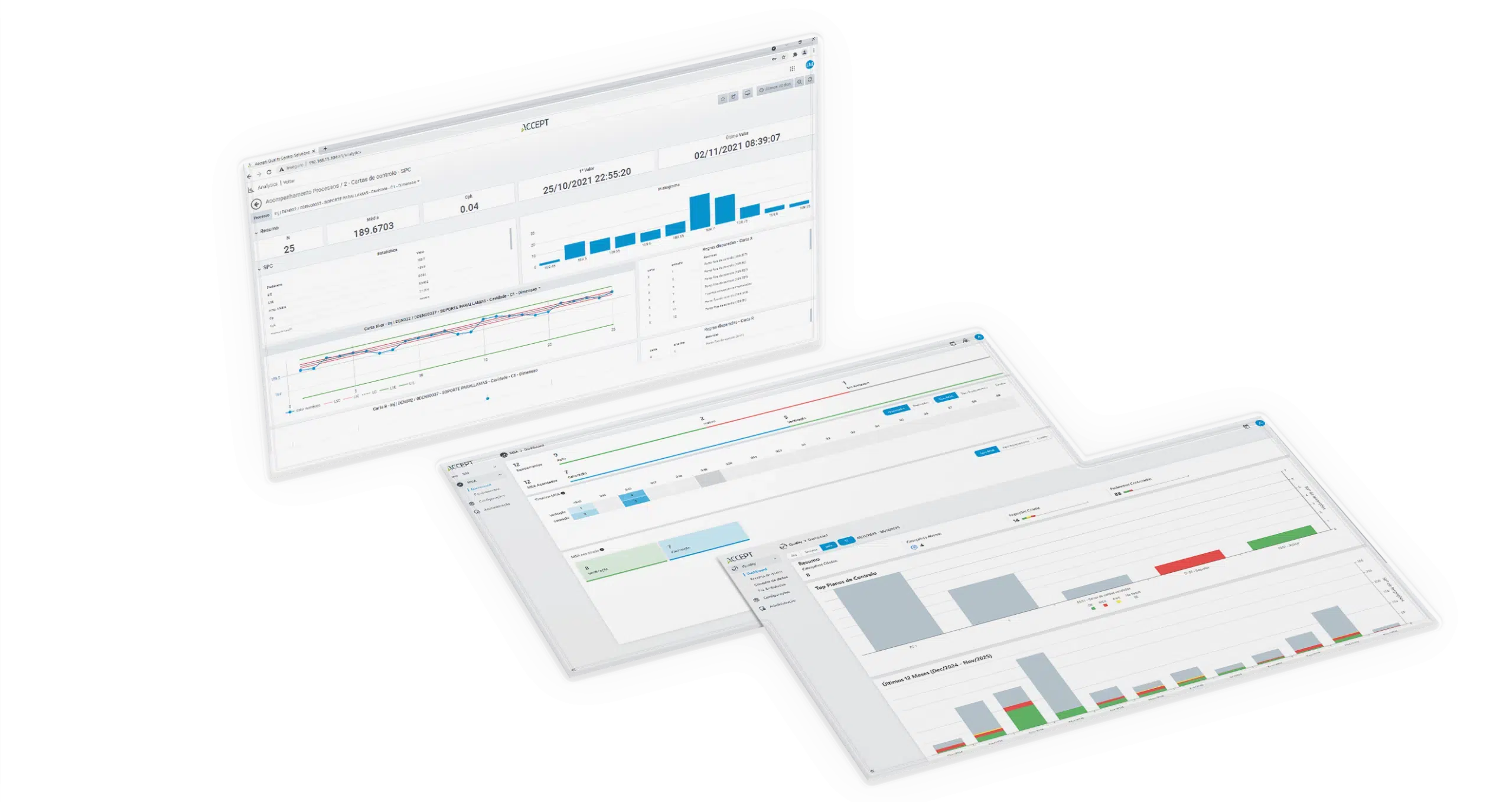
Advanced SPC, with identification of dimensional deviations and trends before rework.
-
Direct integration with measurement equipment, eliminating transcription errors.
-
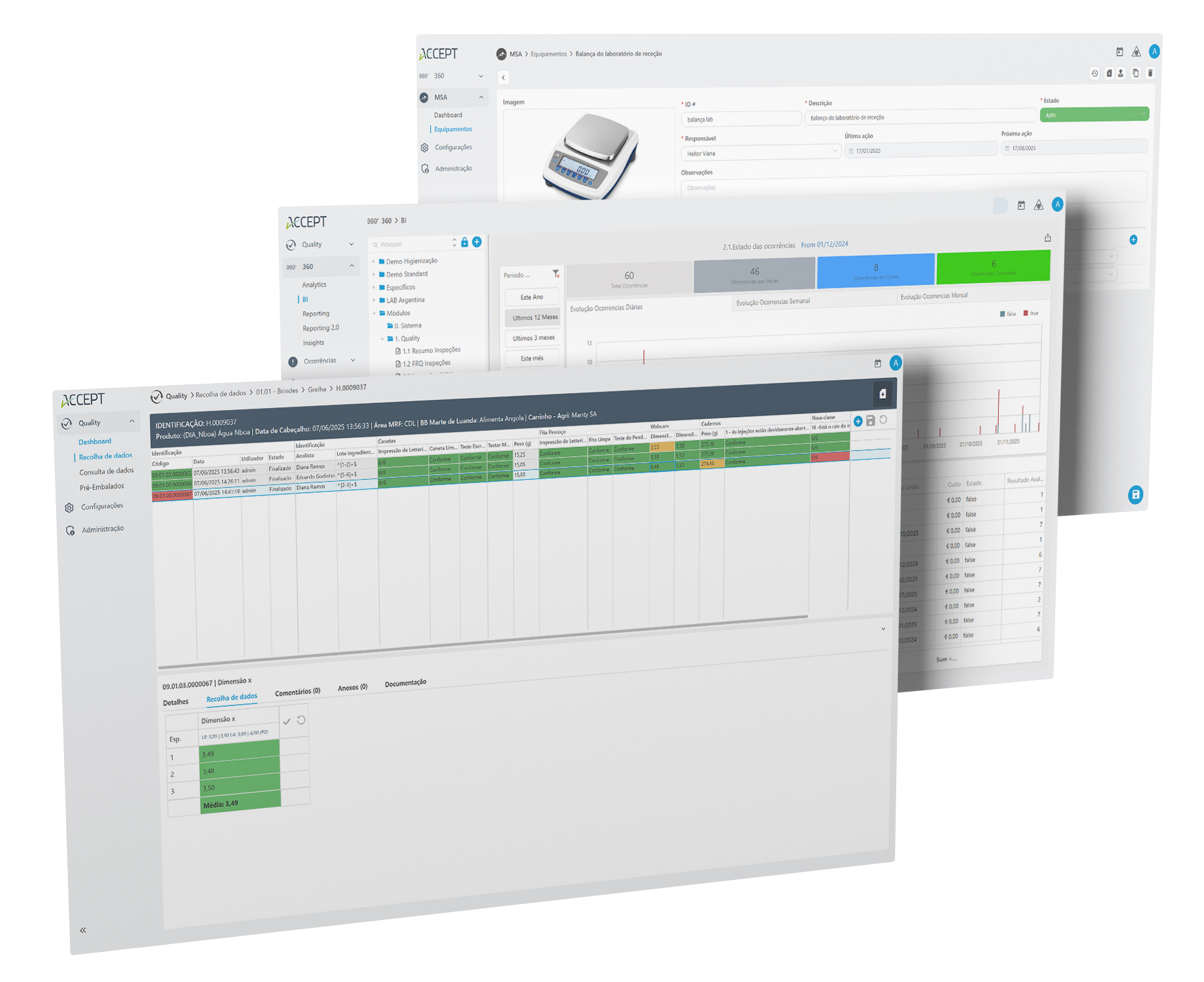
Validation of instruments and operators in critical measurements.
-
Management of nonconformities, try-out adjustments, and correction requests.
-
Identification of energy waste in CNC machines and auxiliary equipment.
-
Dashboards by mould, product, machine, or project phase.
Key features for the mould industry
Each ACCEPT module contributes to more controlled, predictable, and profitable projects.







Direct benefits for the mould industry
- Significant reduction of rework through early detection of deviations
- Greater metrological reliability supported by MSA studies
- More stable manufacturing processes with real-time SPC
- Lower energy consumption in intensive operations
- Continuous information flow, without scattered spreadsheets
- Complete traceability required by the automotive and aerospace sectors
- Organised management of events, accelerating corrections and decision-making
Who is already using ACCEPT in the mould industry



Alongside those driving the food industry forward
We believe that the best solutions are born in the field. That is why we work side by side with the mould industry on every project we implement Hear from those who are already experiencing ACCEPT.

“ACCEPT saves time when using checklists. It also offers the advantage of making the document immediately available in digital form.”
FAQs on Dimensional Control in the Mould Industry
What is dimensional control in the mould industry?
Dimensional control in the mould industry involves measuring and verifying the dimensions and tolerances of parts throughout the production process. It ensures mould precision, identifies deviations, and guarantees that parts meet the required technical specifications.
Dimensional control is not a single action performed at the end of production. It is a continuous discipline that spans every phase of the mould manufacturing cycle, from the first machined component to the final try-out. At each stage, specific dimensions and geometric characteristics must be measured and compared against engineering drawings and customer-defined tolerances to confirm that the part is progressing within acceptable limits.
How do you ensure precision in the mould industry?
Ensuring precision in the mold industry requires rigorous measurement control, part validation at different stages of the process, and continuous monitoring of critical tolerances. Continuous monitoring allows deviations to be identified and problems to be prevented in subsequent phases, such as try-out or series production.
How do you reduce rework in mould manufacturing?
Reducing rework in mold manufacturing involves the early detection of dimensional deviations and continuous part validation. Effective dimensional control allows errors to be corrected in a timely manner and repeated adjustments that impact costs and deadlines to be avoided.
How do you validate parts and moulds throughout the production process?
Parts and molds should be validated through regular measurements and comparison against defined technical specifications. The use of structured checklists helps ensure consistency in control and prevent failures throughout the production process.
Validation is not a one-time event but an ongoing process that must be built into every stage of mold manufacturing. From the first machined component to the final assembly and try-out, each phase presents specific validation requirements that must be met before the work can progress to the next step. Skipping or rushing these checkpoints is one of the most common causes of costly rework and project delays in the mold industry.
Effective part and mold validation begins with clearly defined acceptance criteria. Engineering teams must establish, in advance, the dimensional tolerances, geometric requirements, and surface finish standards that each component must meet at each phase. These criteria serve as the reference point against which all measurements are compared, ensuring that validation decisions are objective and consistent regardless of who is performing the inspection.
As molds become more complex and customer requirements more demanding. Particularly in the automotive and aerospace sectors. The need for structured, traceable validation processes has grown significantly. Customers increasingly require documented evidence that every critical dimension has been verified and that any deviations have been properly addressed. A digital platform like ACCEPT allows validation records to be stored, organized, and retrieved instantly, making it easier to demonstrate compliance, respond to customer queries, and support continuous improvement across projects.
Why is dimensional control important in the mould industry?
Dimensional control is essential for ensuring the quality and functionality of molds. Small deviations can compromise the final performance of the part and lead to rework and delays, making this control critical at every stage of the production process.
How do you control tolerances in the mould industry?
Controlling tolerances in the mold industry requires precise measurements, clearly defined limits, and continuous monitoring of results. Rigorous tolerance management ensures part conformance and prevents critical deviations.
How do you centralise measurement data and improve dimensional control in the mould industry?
Centralising measurement data allows tolerances to be monitored, parts to be validated, and deviations to be identified throughout the entire production process. Solutions like ACCEPT help integrate quality, measurement, and production information into a single platform, making dimensional control in the mold industry easier and supporting faster, more informed decisions.
In traditional mould manufacturing environments, measurement data is often scattered across spreadsheets, paper records, and disconnected systems. This fragmentation makes it difficult to track the evolution of a part across different production phases, compare results between operators or machines, and identify recurring patterns that could indicate systemic issues. By centralising this data in a single digital platform, teams gain a unified view of the entire process. From initial machining through to final try-out validation.
Do you want to reduce rework, improve precision, and accelerate try-outs?
Schedule a demo and see how ACCEPT supports dimensional control, traceability, and efficiency in the mould industry.